Topics and highlights of FACHPACK 2025 in Nuremberg – a report
FACHPACK is one of Europe’s leading trade fairs for packaging, technology and processes, bringing together experts from industry and research. This year, the event took place in Nuremberg from 23 to 25 September, attracting around 1,400 exhibitors to eleven exhibition halls. Thanks in part to the parallel POWTECH TECHNOPHARM event, FACHPACK 2025 attracted a total of around 72,000 visitors – and of course we at BPC were there again.
Under the main theme of “Transition in Packaging” – the same as last year – the focus was on sustainability, regulatory developments – especially the PPWR – and exciting material technologies. With innovations such as the FuturePack Startup Summit on 22 September and the “Converting meets Packaging” pavilion, FACHPACK 2025 placed even greater emphasis on innovation and cross-industry dialogue. Below, we present the highlights of this year’s trade fair.

Packaging trends
As expected, one of THE topics at FACHPACK 2025 was the PPWR, on which we would be happy to advise you individually if required. There were numerous presentations on the new EU Packaging Regulation, which poses challenges of varying degrees for many companies. Some companies presented PPWR-compliant solutions with a focus on recyclability and the circular economy. We saw both initial scalable best practices and interim results of developments that are currently still ongoing. With slogans such as ‘future ready’, manufacturers made it clear that they are prepared for a future with significantly stricter regulations.

High recyclability or high recycled content
Packaging made from fully recyclable and/or recycled materials played a major role. Manufacturers from a wide range of sectors specifically communicated the corresponding advantages of their creations with reference to the requirements of the Packaging and Packaging Waste Regulation and positioned them as sustainable standard solutions for the future. It was striking that ‘100% recyclable’, ‘designed for recycling’ and similar phrases were used as key selling points – a strategy that can still be effective at the moment, i.e. during the transition phase until the PPWR requirements come into full force.

Monomaterial
Composite solutions are often problematic from a recycling and circular economy perspective and are therefore naturally a thorn in the side of the PPWR. So it’s no surprise that monomaterial packaging was very popular at FACHPACK 2025 in Nuremberg – specifically packaging made from single-type plastics and paper solutions. The advantages of monomaterial are obvious: it facilitates separation, recycling and regulatory compliance.
Pulp and fibre
We saw innovations in both flexible and rigid applications. Examples include replacement solutions made from cellulose and fibre for plastic inlays and trays, which can also serve as new barrier layers for sensitive products, among other things. They are considered natural and sustainable and are therefore highly accepted by consumers.


Lightweights
With the aim of conserving resources, reducing the carbon footprint and generating cost advantages in logistics, various exhibitors – primarily from the transport packaging industry, such as containers – showcased materials and structures with reduced weight. They often achieved this through sturdily constructed paper solutions.

Practicality and efficiency of use
At FACHPACK 2025, we also encountered all kinds of practical solutions designed to simplify handling and logistics, thereby increasing time and cost efficiency along the supply chain – for example, anti-slip sheets for pallets and new stretch robots. These address the growing demand for ways to simplify processes and optimise safety.

Exciting machines and materials
In addition to interesting material innovations, FACHPACK 2025 also featured exciting new machines that have the potential to make the production or printing of certain types of packaging significantly more efficient. Below, we present some of the machine and material solutions that particularly caught our attention.
MIMAKI UJV300DTF-75 UV DTF transfer printer
Conventional direct printing is often difficult for round, curved or uneven surfaces, such as those found on bottles, glasses and moulded packaging. This is where the MIMAKI UJV300DTF-75 UV-DTF transfer printer comes into its own. It prints the respective design motif with UV-curing ink onto transfer foil, which is then transferred onto packaging or other objects.
In terms of design, colour and white printing plus clear varnish enable brilliant results with partial gloss/matt effects and a light feel. The high level of detail is impressive. In addition, instant UV curing and the fact that no background film needs to be cut out contribute to fast processing. Typical applications for the transfer printer include premium labels, decorative finishes, and small series or special editions in the packaging and branding world.

Schur Star paper bags
The Schur Star concept enables a flexible and smooth packaging process. Pre-made bags hang on a plastic chain and glide safely through the manually, semi- or fully-automatic machine, where they are precisely opened, filled, sealed and cut.
This special system ensures stable handling even with sensitive materials such as paper. In addition, quick format changes are possible, which is a clear advantage over classic form-fill-seal machines.
The bags presented at the trade fair are mainly made of paper with a thin plastic coating, for example PE. With as little plastic as possible, the bags are basically recycling-friendly and can be used in line with 95/5 criteria.
As clever and practical as the concept itself is, it does have certain ‘green’ limitations. In this context, we must address in particular the role of the plastic chain or carrier web: it is not a permanent part of the bag, but is separated after filling. This creates a separate plastic waste stream, including small bag remnants at the perforated edges.
While the bag appears to be predominantly paper-based and sustainable from the end consumer’s point of view, additional plastic is generated during production. This aspect should not be completely ignored in the overall assessment of the sustainability of the Schur Star paper bag system.


3D-moulded cardboard
In addition to the pulp and fibre variants mentioned above, 3D-moulded cardboard is another innovative alternative to plastic inlays and trays. Made from flat cardboard material, these packaging items are more sustainable than conventional plastic versions.
Compared to cellulose, 3D-moulded cardboard scores points with its higher-quality appearance and clean edges. It allows for individual shapes for a wide variety of products – from chocolates to cosmetics to electronics – and also offers the possibility of embossing, for example with logos or structures for strong branding.

PulProtect – modular protective covers made from moulded cellulose
In addition to customised inlays, there are also modular protective covers made from moulded cellulose that can be used flexibly for various products. They are an interesting alternative to bubble wrap and padded paper, as they offer significantly higher protection against shocks and vibrations.
At the trade fair stand, we were able to see for ourselves how well they protect: a porcelain plate packed in PulProtect survived a fall from a height of approximately 1.60 metres unscathed – even the padding remained intact.
The packaging material, made from 100 per cent recycled cellulose, is extremely flexible: it can be cut to size, folded and interlocked, and adapts to a wide variety of product shapes. Whether bottles, crockery, cosmetics or electronics: PulProtect always guarantees optimum protection.
Disadvantage: due to its distinctive structure, the packaging requires slightly more space, especially for smaller products.

Mondi x Borrmannplus – StretchPaper
The fact that replacing plastic with paper is still relevant was made abundantly clear at FACHPACK 2025 in Nuremberg. The joint solution from Mondi and Borrmannplus also aims to do this and serves as an alternative to conventional stretch film.
Borrmannplus’ semi-automatic pallet wrapping system is specially designed for use with Mondi’s StretchPaper – specifically Advantage StretchWrap. While the wrapping process, the gluing unit and the cutting of the paper are automated, the loading and unloading of the pallets is done manually.
The paper is uncoated, breathable and recyclable in the waste paper stream. It also has an elasticity of eleven percent.
We tested the elasticity ourselves at the trade fair stand and were surprised by the paper’s elasticity and high robustness. However, it is also true that StretchPaper cannot replace plastic stretch film in wet weather or in general when it is damp, but is only suitable for specific, appropriate applications.

Plastic bundles
Although plastic bundles for sales packaging will be phased out in future in accordance with the PPWR, there are still machine concepts for this type of packaging. The reason for this is that almost all machines can now process paper as well as plastic.
However, paper bundles are still only about half as efficient as plastic solutions.
Opinions on this topic varied widely at the trade fair. Some were unimpressed by the upcoming PPWR, while others said they were preparing for major changes.
Examples of suppliers of banding and sleeve solutions include B&B The Packaging Machinery Company and ATS-Tanner GmbH Banderoliersysteme. The latter company has definitely dealt extensively with the PPWR issue and, in cooperation with Mondi, offers paper solutions for bundling food and other products.

pester pac automation – biodegradable wrapping film
pester pac automation GmbH is a provider of automation solutions for end-of-line packaging in the pharmaceutical and consumer goods industries. At its trade fair stand, the company presented specific examples of new sales bundles – specifically solutions made from biodegradable plastic and paper:
– 25 µm thick SOLUTUM film
– Sealable paper wrapping with 37 g/m² in white and 40 g/m² in brown

Other news
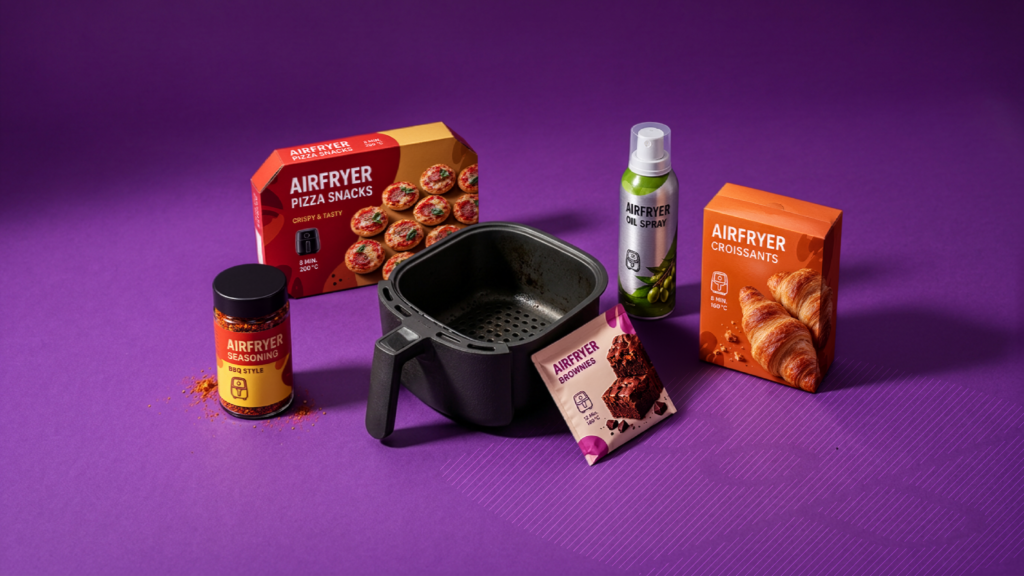
"Air Fryer" on the packaging: Is this the start of a new product category?